Showing posts with label Picture. Show all posts
Showing posts with label Picture. Show all posts
Wednesday, 2 April 2014


Tuesday, 1 April 2014


Sunday, 30 March 2014
Cho Lon Market ~ SaiGon
Cho Lon Market ~ SaiGon
Cho Lon is located at Tran Hung Dao Street, District 5, Ho Chi Minh City.Different name is Binh Tay Market.In 1788, a group of Chinese from Pho and My Tho Islands came to Ben Nghe River Dike and founded a market which developed into the existent Cholon Market, offering a wide array of products. This is Vietnam’s Chinatown market. It is an attractive site for visitors to observe that lively atmosphere.It remains home to more than 500,000 people, many of whom are of Chinese origin. The area and its side-streets and markets provide an interesting glimpse of Sino-Vietnamese life, as the Vietnamese Chinese strive to retain there cultural traditions and language. In addition to temples, traditional apothecaries, fortune tellers and the like, some excellent Chinese food is available in Cho Lon.A visit to Ho Chi Minh City's Cho Lon Market reveals the city at its most vibrant, colourful and fun.This mighty market seems to go on for miles, crammed with every possible kind of fruit, vegetable, nut, fish, meat, cigarette, beer and so on. There are cloth shops with every type of silk in every colour and numerous types of cotton, wool and even tweed!Fabric shopping in Ho Chi Minh City is a serious treat. Give yourself at least an afternoon, if not an entire day, so you can take your time, stop for cold drinks and snacks regularly and avoid becoming hot and bothered!The variety of goods here is positively astounding and will give you uncanny glimpses into modern Vietnamese life. Friendly bargaining should you 20% to 40%, but don't take it too seriously - Vietnamese people very rarely get angry in public and they feel extremely embarrassed if you do.
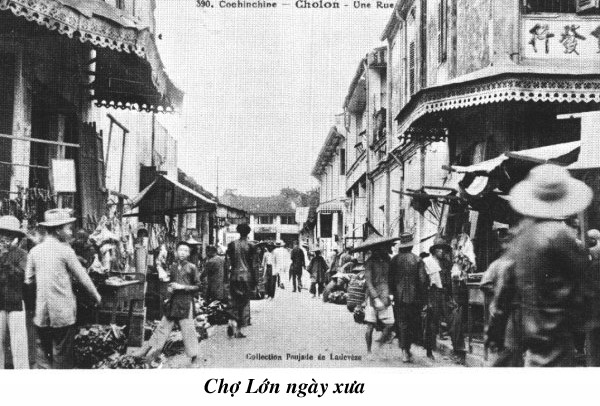
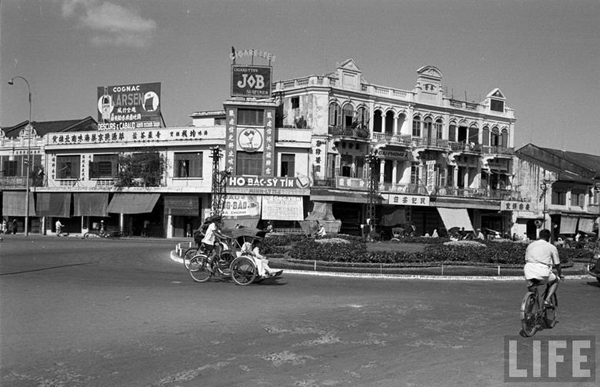
Whenever Chợ Lớn (or Cholon in some documents) is referred to, everyone may immediately think of a Cholon – China Town inside Ho Chi Minh City. It is the name of the Chinese district in Ho Chi Minh City (or Saigon), the largest Chinatown district in Vietnam. It lies at the West bank of the Saigon River, Tran Hung Dao Boulevard, comprising several markets, in which Binh Tay Market is the central one. Today, Cholon has become part and parcel of every itinerary to this significant city. Cholon now covers a vast area from the residential quarters in Districts 5 and 10 to the vicinity of Districts 6 & 11. The Hoa people living there still preserve their age-old cultural, architectural, and religious values. The classical beauty of their architectural style finds expressions in rows of tile-roofed houses, which seem to be caught forever in a brownish gray color.History
History
Chợ Lớn literally means "big" (lớn) "market" (chợ). In 1778, the Hoa (Chinese minority of Vietnam) living in Bien Hoa had to take refuge in what is now Cholon because they were retaliated against by the Tay Son forces for their support of the Nguyen lords. In 1782, they were again massacred by the Tay Son and had to rebuild. They built high embankments against the flows of the river, and called their new settlement Tai-Ngon (meaning "embankment" in Cantonese).Incorporated in 1879 as a city which was 11 kilometers from Saigon, it had expanded and became coterminous with Saigon by the 1930s. On April 27th, 1931, the two cities were merged to form Saigon-Cholon by the French colonial government. By 1956, the name Cholon was dropped from the city name. These days, Cholon attracts a number of tourists, especially those from Mainland China and Taiwan. Aso, it is known as a scenario of Marguerite Duras's autobiographical novel The Lover (1984), where the young French girl fell in love for the first time with her Chinese lover.
Daily life
During daylight, Cholon is bustling with buyers and sellers trading goods. Binh Tay Market, one of the most important markets of Ho Chi Minh City, is located inside Cholon. It can be said that nothing is not sold here. Three or four-star hotels, restaurants, including Aquatria, Dong Khanh, Bat Dat, Ngoc Lan Dinh, Soai Kinh Lam, Ai Hue, Thien Hong, and A Dong, the fairly popular names in Sai Gon. Tourists getting around this famous market town mostly can find here anything they may think in mind!
When night falls
In the evening, Cholon seems to rejuvernate. From distance, one can see neon signs of various sizes, shapes, and colours. Tourists flock into this area not only for purchasing goods but tasting the gastronomy of the Hoa as well.
In this lively area, visitors can enjoy mouth-watering dishes, such as dumplings, Duong Chau fried rice, Tu Xuyen tofu, and so forth.
The majority of tourists to Sai Gon and Cholon are lured by this vast goods-covering market town, glistening when night lights are turned on. This is the panaromic picture of Saigon-Cholon, please come and explore!
Friday, 28 March 2014
12 Pictures of Cho Lon From Before You Were Born

Cho Lon is one of Saigon’s oldest and most interesting neighborhoods. Spanning much of Districts 5 and 6, this predominantly Chinese area has been an integral part of Saigon’s economy since its establishment in 1778. When Cho Lon was incorporated as a city in 1879, it lay 11km from Saigon. By the 1930’s it had grown so rapidly that their borders touched and the two were merged to form Cholon-Saigon in 1931. The name stood until 1956 when the city came to be known simply as Saigon.
Click through for 12 photos of Cho Lon, from trading outpost to economic hub, from before you were born.

7 Old Pictures of Saigon Street Vendors

The buildings and streets of Saigon can change in the blink of an eye. Gone are the streetcars, French street names and ox-drawn carts. As the economy continues to develop, the old Saigon is being replaced by skyscrapers, metros and Burger Kings. However, there are elements of the city that have barely changed over the last century, one of these are street vendors.
Check out the slideshow below of Saigon street vendors taken between 1900 and 1975. Can you identify any of the locations?
8 Old Pictures of Cars in Saigon

Bentleys, BMWs and Mercedes are all over Saigon these days. Though cars have been present in the country since the turn of the 20th century, decades of war (1941 – 1975) and an economic stagnation (1975 – 1986) drastically reduced the number of vintage automobiles in Vietnam. One will sometimes see an old Ford Mustang or VW Bug around town but they are very rare and often imported. For many, it’s hard to imagine sweet old Citroens and ’57 Chevys puttering about town. That’s why we’ve put together this awesome slideshow of Saigon’s vintage transportation methods!
8 Old Pictures of Saigon's Canals

Saigon has long been a city of canals; even Nguyen Hue Street used to be one.
But today, as the city's infrastructure continues to prioritize roads, many canals have ceased to function as commercial routes.
Let's look back at some pictures of the city's canals when they acted as highways for people and goods.
11 Old Pictures of People in Saigon

We spend a lot of time writing about old buildings and changes to Saigon's skyline, but today, we take a closer look at the people of past Saigon.
The clothing and hair styles may seem a bit antiquated but it's clear that day-to-day life in the city has changed less than one may think.
Enjoy!
Slideshow: 12 Old Pictures of Advertisements in Saigon

These days, advertisements are making a big comeback as evidenced by their increasing frequency on Saigon’s streets. And more are coming - the HCMC People’s Committee recently reversed the ban on bus advertising.
Let’s take a stroll down memory lane and look at 12 ads from pre-1975 Saigon.
Enjoy!
Slideshow: Saigon Past and Present in a Single Image

This collection of images, called Ghosts of the Past, was created by Staffan Scherz. Head over to his Flickr page to see more.
12 Old Pictures of Saigon Canals

Before the construction of large urban markets, trade was conducted on rivers and canals, allowing farmers and fisherman to easily offload and sell their wares.
Over the last 50 years the role of canals has changed significantly - roads have been built, the canals have been dredged, walled and polluted. Life no longer takes place on the water but beside it.
As Saigon undergoes slow but steady beautification, many canals have been cleaned, lined with trees and some have even lost their industrial stench.
Check out the slideshow below for pictures of Saigon's canals when they were they city's economic lifeblood.
Old Saigon Picture of the Day: Art Deco
Old Saigon Picture of the Day: Art Deco

When the French occupied Vietnam, they brought many elements of their home country with them. Even today, from architecture to food, the colonial footprint can still be seen.
At the height of French influence in the first half of the 20th century, downtown Saigon exemplified this influence as seen in the picture above.
That art deco lettering is goddamn beautiful.
Thursday, 27 March 2014
Old Saigon Picture of the Day: Go Vap (1930)

There's little to be found in English about the development of Saigon's outer districts. Like much of the city's colonial urban history, if records do exist, they're likely buried in some Parisian archives.
For now, we'll just have to use pictures like this!
If you have any information about the history of Go Vap District, please let us know!